← All guides

Seasonal Guide

Wet Season Home Security in Darwin: Getting Your System Through to April

The wet season is the annual stress test for every alarm and camera system in Darwin. Humidity climbs through the build-up, storms arrive with lightning and outages, and the systems that were installed without the Top End in mind start misbehaving — false alarms at 2am, flat batteries, recorders that didn't survive the last blackout.

Get a Quote

If your house sits empty over the holidays while you're down south, the stakes are higher again: the wet is also when an unoccupied home is most obviously unoccupied. Here's what the season actually does to home security gear, and how to set yours up to run clean through to April.

What humidity does to sensors and batteries

From October the air stays saturated for months, and electronics that live in roof spaces, garages and eaves cop it hardest.

Motion detectors (PIRs). Moisture ingress and condensation inside a detector's optics are behind a large share of wet-season false alarms. A PIR mounted on an exterior-facing wall of an unsealed room — garages and verandah-adjacent rooms are the classics — cycles through humid air daily. Quality detectors with sealed optics handle it; budget detectors drift, false-trigger, or die. If one particular zone throws phantom alarms every build-up, that detector is telling you something.

Reed switches and door contacts. Corrosion on contacts and terminals builds slowly and then presents suddenly as a zone that won't seal or chatters open and closed. Louvre and sliding-door contacts near the coast corrode fastest.

Backup batteries. The sealed lead-acid battery inside an alarm panel is rated for a moderate climate. Heat is the enemy of battery life, and a panel in a Darwin garage or storeroom runs hot for half the year — so batteries here age noticeably faster than the label suggests. A battery that tests fine in July can be unable to hold the house through a four-hour storm outage in December. We treat wet-season readiness checks as the natural time to load-test and replace them; a marginal battery isn't worth carrying into the storm months.

Insects. Not humidity, but the same season: ants and geckos love warm enclosures, and both cause genuine faults — ants nesting in sirens and detectors, geckos triggering PIRs. Sealed conduit entries and insect-resistant detector housings are small line items that save call-outs.
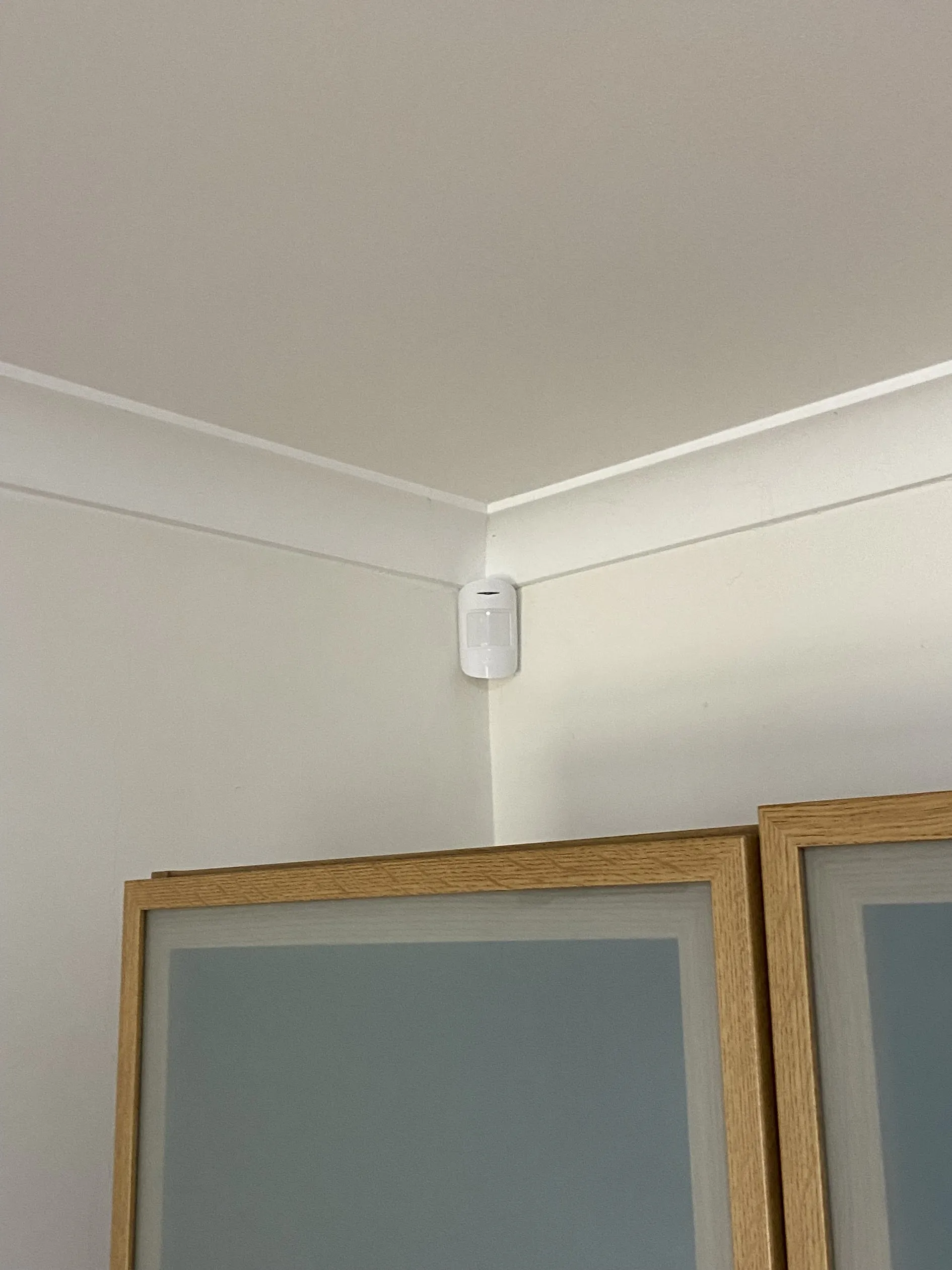
PIR motion detector installed in a home

Storm-triggered false alarms — and how to stop them

Every big storm cell that rolls over the northern suburbs produces a wave of alarm activations, and most are avoidable. The usual causes:

  • Pressure and vibration on doors and windows. Squalls flex doors in their frames; a loosely adjusted contact reads that as an opening. The fix is mechanical — adjust the contact gap and the door furniture, don't just bypass the zone.
  • Outdoor detectors reading rain and debris. Palm fronds, wind-blown foliage and sheeting rain will trigger a cheap outdoor PIR endlessly. Dual-technology detectors (PIR plus microwave, both required to trip) nearly eliminate weather falses outdoors.
  • Power blips masquerading as tampers. Brown-outs during storms can cause older panels to log tamper or fault events that ring through as alarms.
  • Lightning transients. Induced spikes on long cable runs can flash a zone open. Surge protection at the panel helps; so does replacing perished cable before the season.

False alarms aren't just annoying — they train you and your neighbours to ignore the siren, which defeats the entire system. A system that only speaks when it means it is the goal, and it's achievable here with the right detectors and a pre-season service. If your panel already has form, our alarm repairs page covers diagnosis.

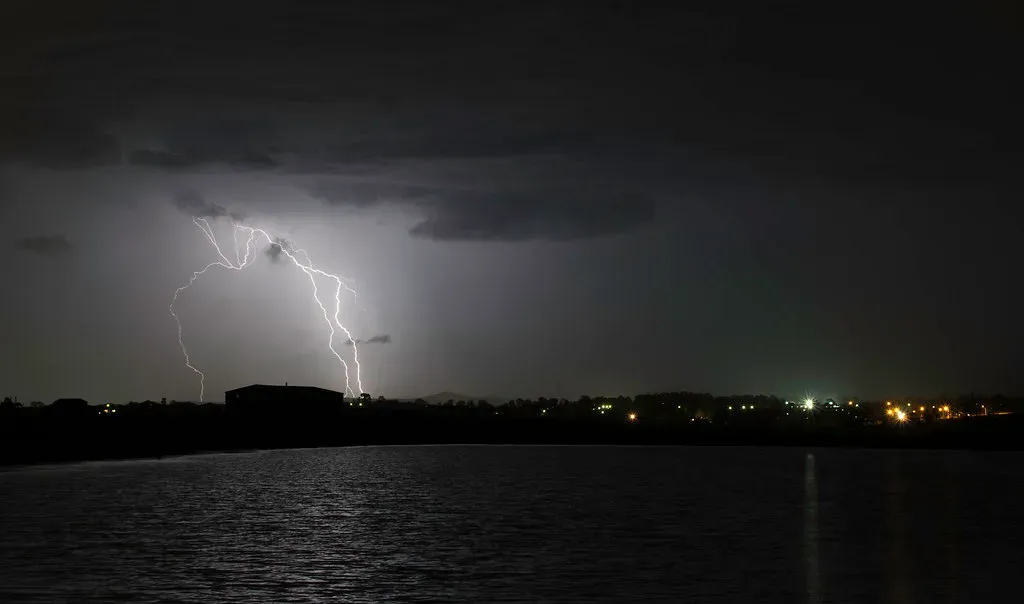
Lightning strikes over water during a night storm

Power outages: the four-hour problem

Storm outages across Darwin and Palmerston are a fact of the season, and they expose the difference between a system that was installed and one that was engineered.

The panel. A healthy backup battery should carry an alarm panel through a typical outage with hours to spare. The failure mode is the battery nobody has tested since installation — the panel switches to battery, runs it flat, then drops offline entirely, and the house is unprotected precisely when the streetlights are out.

The cameras. Most home CCTV runs from a recorder and PoE switch with no backup at all, which means every camera on the house is off for the duration of every outage. A small UPS on the recorder and switch keeps cameras and recording alive through the common short-to-medium outage, and cleanly shuts things down in a long one — which also protects the recorder's hard drive from the corruption that dirty power causes. More on wet-season camera behaviour in our wet season CCTV problems guide.

The NBN. Worth knowing: standard NBN equipment goes down with the power, taking Wi-Fi cameras, app notifications and internet-connected alarm reporting with it — even if your devices themselves have battery. Which leads to monitoring.

Staying monitored through an outage

An alarm that can't report is a siren and nothing more. Through storm season, the communication path matters as much as the sensors:

  • 4G communicators in the alarm panel report over the mobile network, independent of your home internet and power (they run from the panel's battery). This is the single biggest resilience upgrade for a Darwin alarm.
  • Dual-path reporting — internet primary, 4G fallback — is the standard we fit for monitored alarms: the panel switches paths automatically when the NBN drops.
  • Monitoring means someone acts on the signal — including mains-fail and low-battery events, which in the wet are early warnings worth having. If you're interstate for Christmas, that's the difference between finding out in real time and finding out in January.

The pre-wet checklist

What we cover in a pre-season service, and what you can sanity-check yourself:

  1. Load-test the panel battery; replace if marginal
  2. Walk-test every zone; investigate any that chatter
  3. Check and reseal detector and siren housings; treat for ants
  4. Inspect exterior cable runs for UV damage
  5. Confirm the panel reports on both paths (trigger a test signal)
  6. Add or test UPS backup on CCTV recorder and network gear
  7. Trim vegetation out of camera views and detector zones before the storms do it for you

Get a Quote

Tell us about your property and we'll come back with practical options and honest pricing.

Wet Season Security Questions

Why does my alarm go off during storms in Darwin?
Usually flexing doors on loosely adjusted contacts, cheap outdoor detectors reading rain and moving foliage, or power blips upsetting an older panel. Each has a specific fix — bypassing zones every storm season isn't one of them.
How long will my alarm run in a blackout?
A healthy backup battery typically carries a panel through several hours; Darwin heat shortens battery life, so "healthy" needs verifying annually. A flat or aged battery can mean the system drops out within the first hour of an outage.
Do my security cameras work when the power is out?
Not unless the recorder and switch are on a UPS — most home systems aren't, so every outage is a recording gap. A small UPS keeps cameras running through common outages and protects the recorder from power-related corruption.
Will my monitored alarm still report if the NBN goes down?
Only if it has a 4G communicator or dual-path reporting. Standard NBN equipment loses power in a blackout, so internet-only reporting fails exactly when you need it. 4G reporting from the panel's battery keeps the link alive.
When should I get my system serviced ahead of the wet?
September–October, before the build-up peaks. That leaves time to replace marginal batteries and perished cable before the first big storms rather than during them.
We go south over the holidays — what matters most?
Monitoring with 4G reporting, a tested battery, UPS-backed cameras you can check remotely, and someone local as a keyholder contact. An unoccupied house in the wet needs the system to run unattended for weeks — that's a resilience question, not a sensor-count question.

Get your system wet-season ready

We install and service home security systems built for Top End conditions — sealed detectors, tested batteries, dual-path monitoring and backup power that carries you through the storms.

Get a Quote